
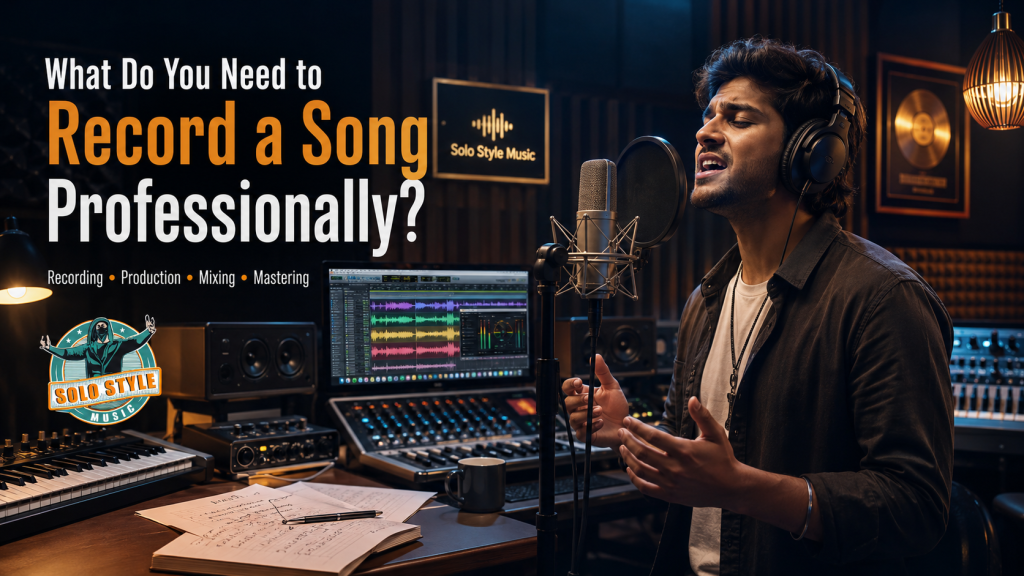
Have you ever wondered what you need to record a song professionally? If you are a singer, rapper, songwriter, or beginner artist planning to release your own music, having a good voice and lyrics is only the beginning.
A professional-sounding song requires the right combination of recording equipment, a suitable studio, music production, vocal recording, mixing, and mastering. The quality of each stage can directly affect how your final song sounds.
The good news is that you don’t have to manage everything yourself. A professional music studio such as Solo Style Music can help artists take their ideas from the initial concept to a finished track.
Let’s understand what you actually need to record a song professionally.
1. A Strong Song Idea
Before entering a recording studio, you need a song idea.
This could start with:
- Lyrics
- A melody
- A beat
- A hook
- A concept
- A complete song composition
You don’t necessarily need to have everything perfectly prepared. If you have lyrics and a basic melody but don’t know how to develop them into a complete song, a music producer can help.
The clearer your creative direction is, the easier it becomes to develop the final track.
2. Professional Recording Studio
One of the most important things required for professional song recording is a suitable recording environment.
A professional studio provides an acoustically treated space designed specifically for recording vocals and instruments. Unlike a normal bedroom or office, a studio is designed to control unwanted echoes, outside noise, and reflections.
The recording environment can make a major difference in the clarity and quality of your vocals.
When choosing a studio, look at its recording setup, previous work, equipment, and overall environment.
3. A Quality Microphone
Your microphone is one of the most important pieces of equipment for vocal recording.
Professional studios usually have different microphones that can be selected according to the singer’s voice and the requirements of the song.
A good microphone captures details, dynamics, and character in your voice.
However, simply buying an expensive microphone doesn’t automatically create a professional recording. The microphone needs to be used correctly, with proper positioning, gain settings, room acoustics, and recording techniques.
That’s why professional equipment and an experienced recording engineer should work together.
4. Professional Audio Interface and Recording Setup
A professional recording setup also requires an audio interface and reliable recording software.
The audio interface helps convert the microphone’s analog signal into a digital signal that can be processed and recorded by a computer.
Professional studios also use Digital Audio Workstations (DAWs) for recording, editing, arranging, and producing music.
The exact software and equipment may vary between studios, but the important thing is having a reliable setup capable of capturing clean, high-quality audio.
5. An Experienced Recording Engineer
Equipment is important, but the person operating it matters just as much.
A recording engineer handles technical aspects such as microphone placement, recording levels, monitoring, and session management.
For beginners, an experienced engineer can be especially helpful. They can guide you through microphone technique, help you maintain consistent vocal levels, and make the recording process more comfortable.
If this is your first studio session, having someone who understands how to work with artists can make a big difference.
6. Music Production
If you have lyrics but don’t have a complete instrumental, you may need music production.
A music producer can help transform your initial idea into a complete musical arrangement.
Depending on the song, production may include:
- Creating the instrumental
- Choosing sounds and instruments
- Developing the beat
- Creating arrangements
- Building song sections
- Adding musical layers
- Selecting suitable effects
For an independent artist, this stage can turn a simple idea into a professionally structured song.
7. Good Vocal Preparation
Professional equipment cannot replace preparation.
Before your recording session, practice your lyrics and melody. Make sure you understand the song structure and know where you need to change your vocal intensity or emotion.
You should also take care of your voice before recording. Avoid unnecessary strain and make sure you are comfortable and prepared for the session.
During recording, don’t worry if you don’t get everything right in one take. Professional sessions often involve multiple takes.
The goal is to capture the best possible performance.
8. Professional Editing
Once the recording is completed, the vocals and other tracks may need editing.
Editing can include selecting the best takes, cleaning unwanted noise, adjusting timing, and organizing different sections of the song.
This stage helps prepare the recorded material for mixing.
However, editing should be done carefully. The goal is to improve the recording while keeping the natural character and emotion of the artist’s performance.
9. Mixing
Recording your vocals is not the final step.
After recording and editing, your song needs mixing.
Mixing involves balancing different elements of the track, including vocals, instruments, drums, bass, and effects.
A mixing engineer may adjust volume, equalization, compression, reverb, delay, and other effects to create a balanced sound.
Good mixing ensures that the vocals remain clear while the instrumental supports the song instead of overpowering it.
10. Mastering
The final major stage is mastering.
Mastering prepares the completed song for distribution and helps it sound consistent across different playback systems.
A professionally mastered track should work well on headphones, speakers, cars, phones, and other common listening environments.
Mastering also helps prepare your song for platforms where you plan to release your music.
This is why mixing and mastering should be considered an important part of professional song production rather than an optional final touch.
11. A Comfortable Creative Environment
Professional recording is not only about technology.
The artist also needs to feel comfortable.
A relaxed environment can help singers and musicians focus on their performance and express the emotion of their song naturally.
This is particularly important for beginners who may feel nervous when recording for the first time.
The right studio should give you both professional technical support and a comfortable creative environment.
12. Solo Style Music: From Your Idea to a Finished Song
If you are looking for a place to bring your musical idea to life, Solo Style Music can support you through different stages of the music-making process.
Whether you are starting with lyrics, a melody, or an original concept, creating a finished song involves several steps.
Solo Style Music can help artists with areas such as song recording, music production, vocal recording, mixing, and mastering.
This can be especially useful for beginners because you don’t have to figure out every technical detail on your own. You can focus on your lyrics, vocals, creativity, and performance while experienced professionals handle the production side.
For independent artists, having access to the different stages of music creation in one professional environment can also make the overall workflow simpler and more consistent.
Your first song doesn’t need to start with a huge budget or complicated setup. It needs a good idea, preparation, the right professionals, and a studio capable of turning that idea into a finished track.
Common Mistakes to Avoid
If you are planning your first professional recording, avoid these mistakes:
Recording without preparation: Practice your lyrics and melody before the session.
Choosing a studio only because it is cheap: Consider quality, experience, equipment, and services.
Ignoring production: Good vocals alone cannot create a complete song.
Skipping mixing and mastering: These stages are essential for a polished final track.
Trying to do everything yourself: Professional guidance can save time and improve the overall result.
Final Thoughts
So, what do you need to record a song professionally?
You need a strong song idea, good preparation, a professional recording studio, quality equipment, an experienced recording engineer, music production, vocal recording, editing, mixing, and mastering.
Most importantly, you need a team that understands your musical vision.
Whether you are recording your first original song or preparing your next release, Solo Style Music can help you move from an idea to a professionally produced track.
Your song starts with an idea—but the right recording process can turn that idea into music that people can actually hear, remember, and enjoy.