
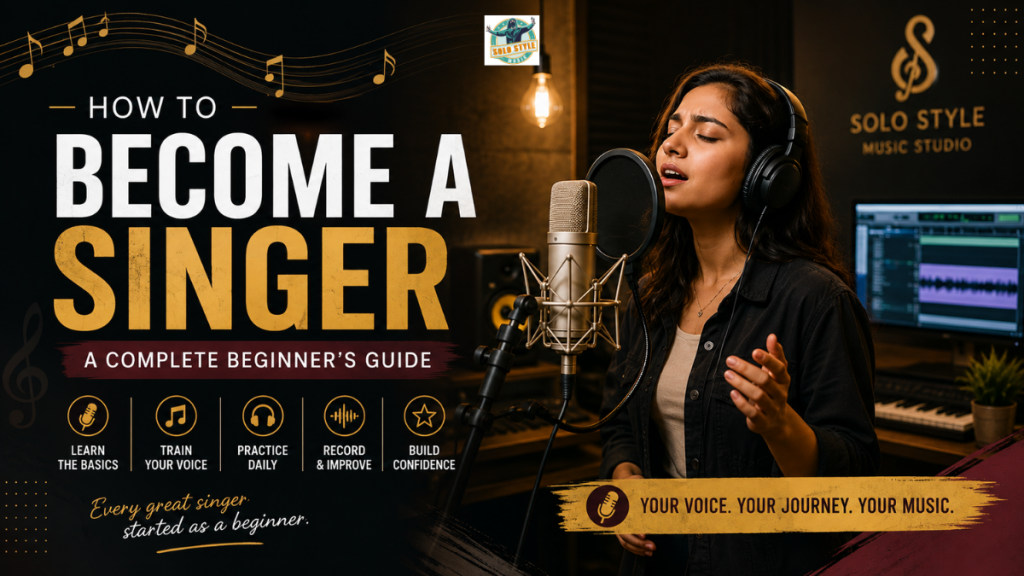
Have you ever found yourself singing along to your favourite songs and wondering, “Can I become a singer too?” The answer is yes.
You don’t need a perfect voice, a huge social media following, or professional experience to start. Singing is a skill that can be developed through proper training, regular practice, confidence, and experience.
At Solo Style Music Studio, we often meet beginners who have a genuine passion for singing but aren’t sure where to begin. The good news is that you don’t have to figure everything out at once. With the right approach, you can gradually develop your voice and become a more confident singer.
Here’s a complete beginner’s guide to help you understand how to become a singer, what you need to learn, and how to start your musical journey.
1. Understand Your Voice
Before attempting difficult songs, take time to understand your own voice.
Every singer has a different vocal range, tone, texture, and natural strength. Some voices may be soft and smooth, while others may naturally sound powerful or deep.
As a beginner, focus on:
- Identifying your comfortable vocal range
- Understanding your natural voice
- Recognising notes that feel difficult
- Learning where your voice feels strongest
- Avoiding unnecessary strain
Don’t compare your voice with professional singers. Your initial goal should be to understand and develop your own voice.
2. Learn the Basics of Singing
Passion is important, but proper technique makes a significant difference. Start by learning fundamental concepts such as:
Breathing: Proper breathing helps you control your voice and sustain notes.
Pitch: Pitch refers to how high or low a musical note is. Singing notes accurately is one of the most important skills for any singer.
Rhythm: Staying in time with music helps your vocals sound controlled and musical.
Voice Control: Good singers learn to control volume, tone, transitions, and dynamics instead of simply singing loudly.
Pronunciation: Clear pronunciation makes lyrics easier to understand and helps make your performance more expressive.
These fundamentals form the foundation of strong singing.
3. Consider Professional Singing Lessons
One of the best ways for beginners to improve is to learn from an experienced vocal trainer.
Professional guidance can help you understand:
- Whether you’re singing in the correct pitch
- How to use your breathing properly
- Which vocal exercises suit you
- How to expand your vocal range safely
- How to improve voice control
- How to correct common singing mistakes
At Solo Style Music Studio, beginners can learn in a comfortable environment without feeling judged. A good singing class should not simply teach you songs—it should help you understand your voice and build a strong foundation.
4. Practise Vocal Exercises Regularly
Just as athletes train their bodies, singers need to train their voices.
A beginner’s routine can include:
- Breathing exercises
- Gentle humming
- Lip trills
- Vocal warm-ups
- Pitch exercises
- Scale practice
- Sustaining comfortable notes
- Singing simple melodies
You don’t need to practise for hours every day. Consistency is more valuable than occasional long practice sessions.
Even 20–30 minutes of focused practice can help improve your control over time.
5. Choose Songs That Suit Your Voice
A common beginner mistake is choosing songs that are too difficult or outside their comfortable range.
Instead, choose songs that:
- Suit your vocal range
- Feel comfortable to sing
- Match your current ability
- Allow you to focus on technique
- You genuinely enjoy
As your voice becomes stronger, you can gradually challenge yourself with more difficult songs.
The most impressive song isn’t necessarily the right song for your voice.
6. Improve Your Pitch and Musical Ear
If you want to become a professional singer eventually, pitch accuracy is essential.
A simple exercise is to play a note on a keyboard or another instrument and try to match it with your voice. With practice, you’ll learn to:
- Hear a note
- Identify whether your voice is higher or lower
- Adjust your voice
- Match the note accurately
This develops ear training, which is extremely useful for singers.
Listening actively to music can also improve your musical ear. Pay attention to how singers enter notes, change volume, hold notes, and follow rhythm.
7. Record Yourself Singing
Here’s a simple habit every beginner can benefit from: record your singing.
Your voice can sound different to you while singing compared with how it sounds in a recording. Recording yourself helps you notice:
- Pitch problems
- Timing issues
- Pronunciation
- Breathing
- Voice stability
- Areas requiring more practice
Don’t be discouraged by your first recordings. Use them to track your progress rather than judge yourself.
8. Work on Expression and Emotions
Singing isn’t only about hitting the correct notes.
A technically accurate performance can still feel disconnected without emotion. Think about:
- What is the song trying to say?
- What emotion does it carry?
- Which words need emphasis?
- Where should your voice become softer or stronger?
Your goal should be to make the listener feel the song, not simply hear the notes.
9. Build Confidence Through Performance
Many beginners sing comfortably alone but become nervous when someone else is listening.
Start small:
- Sing in front of family
- Perform for close friends
- Join a local music event
- Participate in an open mic
- Perform at your music studio
- Share a recording online
You don’t need to begin with a large audience. Performance experience gradually makes you more comfortable with being heard.
Confidence usually comes from experience.
10. Learn Basic Music Theory
You don’t need extensive theoretical knowledge to become a singer, but understanding basic music theory can be extremely helpful.
Start with:
- Musical notes
- Scales
- Octaves
- Rhythm
- Tempo
- Keys
- Chords
- Time signatures
Understanding music can help you communicate with musicians and make better decisions about songs. For example, if a song feels too high, changing its key may make it much more comfortable to sing.
11. Experiment With Different Singing Styles
Don’t feel pressured to choose one genre immediately.
Experiment with styles such as:
- Pop
- Bollywood
- Classical
- Indie
- Rock
- Acoustic
- Folk
- R&B
- Jazz
Trying different styles can help you discover what suits your voice and personality. Eventually, you may find a particular genre or singing style that feels natural to you.
12. Take Care of Your Voice
Your voice is your instrument, so it needs proper care.
Some useful habits include:
- Stay adequately hydrated
- Warm up before intensive singing
- Avoid excessive shouting
- Give your voice enough rest
- Don’t force high notes
- Practise proper technique
- Stop if singing causes pain
If you experience persistent pain or hoarseness, consult an appropriate healthcare professional or voice specialist.
13. Create a Consistent Practice Routine
If you’re serious about becoming a singer, create a realistic routine that you can maintain.
For example:
5 minutes: Breathing exercises
5 minutes: Vocal warm-up
10 minutes: Scales and pitch exercises
10 minutes: Song practice
5 minutes: Recording and reviewing your performance
You can adjust this routine according to your level and goals.
The key is consistency. Small improvements repeated over time can lead to significant progress.
14. Consider Recording Your First Professional Song
Once you’ve developed some confidence, recording a song can be an exciting milestone.
A professional music studio allows you to experience:
- Studio microphones
- Headphone monitoring
- Professional recording equipment
- Vocal recording techniques
- Multiple takes
- Editing
- Mixing and mastering
Your first recording doesn’t have to be perfect. It can simply be an opportunity to experience professional music production.
At Solo Style Music Studio, we encourage beginners to enjoy the recording process rather than feel pressured to create a perfect song on their first attempt.
Is Everyone Capable of Becoming a Singer?
If you can already carry a tune, that’s great. If you struggle with pitch, that doesn’t automatically mean singing isn’t for you.
Singing is a combination of listening, breathing, coordination, timing, vocal control, and interpretation. Many of these abilities can improve through guided practice.
Instead of asking whether you were “born with a singer’s voice,” ask:
Are you willing to work with the voice you have?
That’s where meaningful progress begins.
What Can You Do With Your Singing Skills?
Becoming a better singer doesn’t necessarily mean pursuing a traditional music career.
You might explore:
Cover Content: Create your own versions of songs and share them online.
Live Performance: Work towards performing at events, cafés, open mics, or other platforms.
Original Music: Collaborate with composers, lyricists, or producers to create your own songs.
Auditions: Prepare for singing auditions as your technique and confidence improve.
Recording Projects: Build a collection of professionally recorded songs over time.
Personal Enjoyment: Continue singing simply because it makes you happy.
There is no requirement to turn every passion into a profession.
When Should You Start Taking Singing Seriously?
You don’t need to make a career decision on your first day.
Perhaps you simply want to become more confident while singing. Later, you may decide to perform, record original music, or explore a professional career.
Your goals can change as your skills develop, and that’s completely fine.
What matters is finding a learning routine you can maintain and a teacher or studio environment where you feel comfortable learning, making mistakes, and trying again.
At Solo Style Music Studio, our approach is simple: understand the singer first, then work on the areas that will make the biggest difference to that individual voice.
Start With Your Own Voice
There are countless singers to admire, but your journey doesn’t need to follow theirs.
Your voice may develop differently. Your strengths may be different. The music you eventually choose may be different too.
Instead of trying to sound exactly like someone else, concentrate on discovering what makes your own voice interesting.
That could be your tone, softness, energy, emotional expression, or a style you haven’t discovered yet.
The journey starts when you stop waiting to sound like a singer and start learning how to use your own voice.
At Solo Style Music Studio, we want beginners to experience exactly that—not pressure to be perfect, but the confidence that comes from understanding, practising, and developing their own voice.