
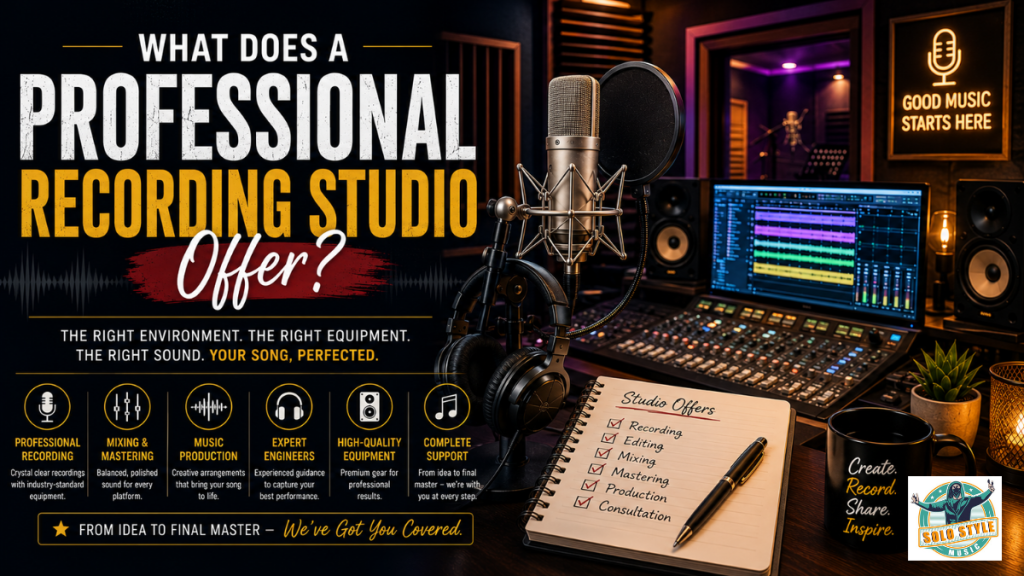
If you are planning to record a song, one of the first questions you may have is: What does a professional recording studio actually offer?
A recording studio is much more than a room with a microphone. Professional music production involves the right equipment, acoustics, experienced engineers, music production, recording techniques, editing, mixing, and mastering. All these elements work together to turn a vocal performance or musical idea into a polished final track.
At Solo Style Music Studio, we work with singers, musicians, beginners, and independent artists who want to bring their musical ideas to life. Whether you are recording your first song or working on your next release, understanding what a professional studio offers can help you make better decisions.
Here are some of the key services and advantages you can expect from a professional recording studio.
1. A Professionally Treated Recording Environment
One of the biggest differences between recording at home and recording in a professional studio is the recording environment.
A professional studio is designed with acoustic treatment to control unwanted reflections, echoes, and outside noise. This allows the microphone to capture a cleaner and more controlled sound.
Room acoustics can have a major effect on vocals and instruments. Even a good microphone may not produce the desired result if it is used in an unsuitable room.
A professionally treated recording space provides a better foundation for the entire production process.
2. High-Quality Recording Equipment
Professional studios generally provide equipment designed specifically for audio recording.
Depending on the studio, this can include:
- Professional condenser and dynamic microphones
- Studio headphones
- Audio interfaces
- Microphone preamps
- Studio monitors
- Mixing consoles
- MIDI equipment
- Musical instruments
- Professional recording software
Different microphones and equipment can produce different tonal characteristics. An experienced recording engineer can help select equipment that works well with the singer, instrument, and style of the song.
3. Experienced Recording Engineers
Equipment alone doesn’t create a professional recording.
The person operating the equipment plays an important role as well.
A recording engineer understands microphone placement, recording levels, headphone monitoring, gain structure, and the technical side of capturing audio.
During a session, the engineer can also help identify problems such as excessive background noise, inconsistent recording levels, or unsuitable microphone positioning.
At Solo Style Music Studio, we believe the recording process should feel comfortable, especially for beginners who may be entering a studio for the first time.
4. Vocal Recording and Guidance
For singers, professional vocal recording is one of the most important services a studio can provide.
The engineer can help you understand how to work with the microphone and headphones while recording.
A session may involve recording several takes of the same section. This gives you and the production team options when selecting the strongest performance.
Professional recording can also help you focus on your delivery, expression, pronunciation, timing, and vocal consistency.
You don’t have to deliver a perfect performance in one take. Recording is a process, and multiple takes are completely normal.
5. Music Production and Arrangement
Some artists already have a complete instrumental, while others only have lyrics and a melody.
A professional music studio may offer music production and arrangement to help develop the song.
Production can involve decisions about:
- Instrument selection
- Tempo
- Song structure
- Chord progression
- Drum patterns
- Bass
- Melodies
- Background vocals
- Vocal layers
- Overall musical style
A producer can help shape the song while keeping the artist’s original vision in mind.
The objective isn’t simply to add more sounds. Every element should have a purpose and contribute to the overall song.
6. Multiple Takes and Vocal Layers
Professional recording sessions allow artists to experiment with their performance.
You may record multiple takes of the main vocal and then add additional parts such as:
- Harmonies
- Backing vocals
- Doubles
- Ad-libs
- Vocal effects
These layers can add depth and character to a song.
For example, a powerful chorus may benefit from carefully arranged backing vocals, while a softer verse might work better with a simpler vocal arrangement.
7. Professional Editing
After recording, the audio may need editing before it moves into the mixing stage.
Editing can include selecting the best takes, arranging recorded sections, correcting timing where necessary, and removing unwanted noises or distractions.
For vocals, appropriate pitch correction may also be used when required.
The goal of editing should be to improve the recording while keeping the artist’s performance natural.
A good production should still sound like you, rather than an artificial version of your voice.
8. Mixing Services
Once recording and editing are complete, the song moves into mixing.
Mixing is the process of making different elements of a song work together.
A mixing engineer may work on:
- Vocal levels
- Instrument balance
- Equalization
- Compression
- Reverb
- Delay
- Stereo positioning
- Vocal clarity
- Overall dynamics
For example, if the music is overpowering the singer, the mix can be adjusted so the vocals remain clear and understandable.
Good mixing creates balance while helping the important elements of the song stand out.
9. Professional Mastering
Mastering is the final stage of audio production.
Once the mix has been completed, mastering helps prepare the song for distribution and different listening environments.
It can involve adjusting the overall tonal balance, dynamics, loudness, and consistency of the final track.
Mastering is different from mixing. Mixing focuses on balancing individual elements, while mastering focuses on the completed stereo mix.
Together, these stages help create a more polished final product.
10. Studio Monitoring
Professional studios use studio monitors and headphones designed for accurate audio monitoring.
This is important because the engineer needs to hear the recording and mix clearly while making production decisions.
Consumer speakers and headphones are often designed to make music sound enjoyable rather than provide a neutral reference.
Professional monitoring helps engineers identify details that might otherwise be missed.
11. A Comfortable Creative Environment
Recording music can sometimes feel intimidating, especially for beginners.
A professional studio should provide an environment where artists feel comfortable experimenting and performing.
When a singer feels relaxed, they may be able to deliver a more natural and expressive performance.
At Solo Style Music Studio, we believe that a recording session should not feel like an examination. It should be a creative experience where artists can learn, experiment, and improve.
12. Professional Advice Throughout the Process
A major advantage of working with a studio is having experienced people involved in the project.
You may have questions such as:
Is this song suitable for my voice?
Should I change the key?
Do I need another vocal take?
Should I add harmonies?
Does the instrumental need more elements?
A professional team can help you evaluate these decisions based on the requirements of the song.
You still remain the artist, but professional guidance can help you avoid unnecessary mistakes.
13. A Complete Production Workflow
One of the biggest benefits of a professional recording studio is that multiple stages of production can be handled within one workflow.
A typical project may look like:
Song Preparation → Music Production → Recording → Editing → Mixing → Mastering
Having a clear workflow makes it easier to move from an initial idea to a finished track.
Instead of worrying about every technical detail yourself, you can focus more on your performance and creative direction.
14. Who Can Benefit From a Professional Recording Studio?
Professional studios aren’t only for established singers.
They can be useful for:
- Beginner singers
- Independent artists
- Songwriters
- Rappers
- Musicians
- Content creators
- Bands
- Artists preparing original songs
- People creating professional demos
You don’t need to have a record deal or a large audience to use a recording studio.
For many beginners, their first studio session is simply an opportunity to experience professional music production.
Final Thoughts
A professional recording studio offers much more than a microphone and a place to sing. It brings together quality equipment, controlled acoustics, experienced engineers, music production, recording, editing, mixing, and mastering.
The biggest advantage is the combination of these elements. Good equipment becomes more useful when operated correctly, and a great performance can reach its full potential when it is recorded and produced properly.
At Solo Style Music Studio, our aim is to provide artists with a comfortable and professional environment where they can develop their ideas and create music they are proud of.
Whether you’re preparing your first song or working on an original release, understanding what a professional recording studio offers can help you approach your session with greater confidence.
Your song starts with an idea. The right studio can help turn that idea into a finished recording.