
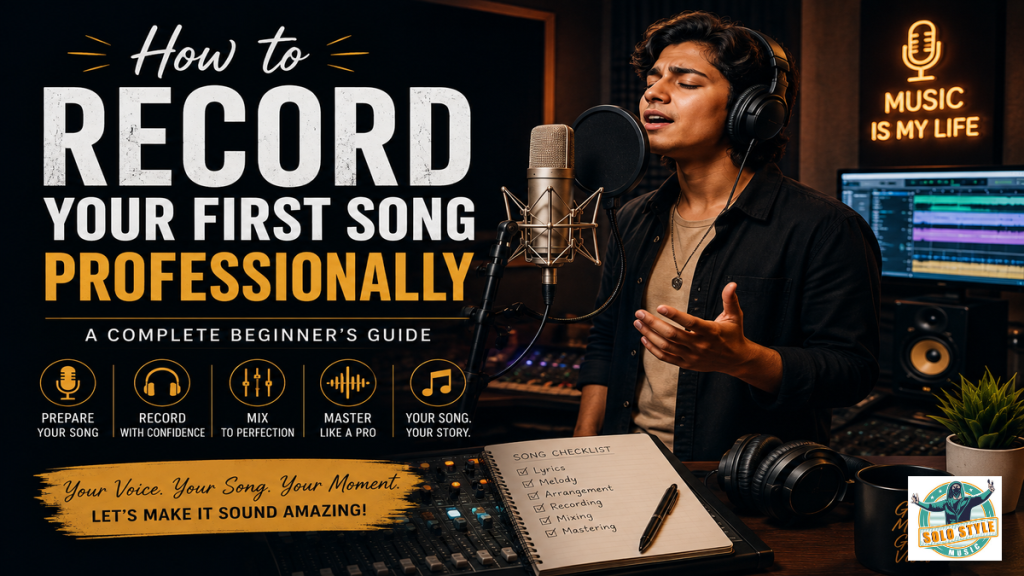
Have you written your first song and wondered what it would be like to hear it as a professional recording? Recording your first song can feel exciting, but it can also be confusing if you don’t know where to begin.
Many beginners think professional recording is simply about standing in front of a microphone and singing. In reality, a good recording involves several steps, including song preparation, vocal recording, music production, editing, mixing, and mastering.
At Solo Style Music Studio, we work with singers and beginners at different stages of their musical journey. From our experience, the best first recording happens when an artist understands the process and arrives at the studio prepared.
Here is a simple guide to help you understand how to record your first song professionally.
1. Start With a Clear Song Idea
Before entering a recording studio, you should have a clear idea of what you want to record.
Your song could be:
- An original composition
- A cover song
- A self-written song
- A song created with a producer
- A demo you want to develop professionally
If you are recording an original song, make sure you have the lyrics, melody, and basic structure ready.
You don’t necessarily need everything to be perfect. A professional music producer can help you develop your ideas further.
2. Prepare Your Lyrics and Melody
Knowing your lyrics well can make your recording session much easier.
Before coming to the studio, practise the song enough that you are comfortable with:
- Lyrics
- Melody
- Song structure
- Entry points
- Difficult sections
- Ending notes
If you keep forgetting lyrics during recording, you may need more takes, which can make the session longer.
At Solo Style Music Studio, we encourage beginners to practise beforehand so they can spend their studio time focusing on performance rather than remembering every line.
3. Choose the Right Music Production
The instrumental arrangement has a major impact on how your final song sounds.
Depending on your song, you may need:
- Drums
- Bass
- Piano
- Guitar
- Synthesizers
- Strings
- Percussion
- Background vocals
A producer can help decide which instruments suit the mood and style of your song.
The goal isn’t to add as many instruments as possible. The arrangement should support your voice and help communicate the feeling of the song.
4. Select a Professional Recording Studio
Choosing the right studio is one of the most important decisions for your first recording.
Look for a studio that offers:
- Good-quality recording equipment
- Suitable microphones
- Proper acoustic treatment
- Experienced recording engineers
- Professional monitoring
- Mixing and mastering services
- A comfortable recording environment
Don’t choose a studio only because it has expensive equipment. The experience of the engineer and the quality of the recording environment also matter.
A good studio should make you feel comfortable enough to perform naturally.
5. Warm Up Your Voice
Avoid arriving at a recording session and immediately attempting your most demanding vocals.
Give your voice time to warm up.
A simple warm-up can include:
- Gentle humming
- Lip trills
- Breathing exercises
- Easy scales
- Comfortable vocal exercises
Avoid excessive shouting or forcing high notes before your session.
Your goal is to prepare your voice without tiring it.
6. Understand the Microphone Technique
Recording in a studio may feel different from singing casually at home.
Your distance from the microphone, movement, volume, and positioning can affect the recording.
Your recording engineer can guide you on:
- Microphone distance
- Vocal position
- Headphone volume
- When to move closer or farther away
- How to handle louder sections
Don’t worry if you don’t know microphone technique beforehand. This is something you can learn during your session.
7. Record Multiple Takes
Your first take doesn’t have to be perfect.
Professional singers often record multiple takes and select the strongest performances later.
During your session, you may record:
- Complete takes
- Chorus sections
- Difficult lines
- Harmonies
- Ad-libs
- Background vocals
If you make a mistake, don’t panic. Simply take a breath and try again.
At Solo Style Music Studio, we want beginners to understand that recording is a process. You don’t have to deliver a perfect performance in a single take.
8. Listen and Improve
One of the most useful parts of a professional recording session is listening back to your performance.
You may notice things that you didn’t hear while singing, such as:
- Pitch issues
- Timing problems
- Unclear pronunciation
- Uneven volume
- Weak sections
- Breathing problems
Listening critically can help you understand your voice better.
However, don’t become overly focused on small imperfections. The aim is to create a natural and expressive performance.
9. Editing Comes After Recording
Once the vocal recording is complete, the engineer can edit the recorded material.
Editing may include selecting the best takes, aligning sections, reducing unwanted noise, and making necessary timing adjustments.
Some vocal correction may also be used when appropriate.
However, editing should support the performance rather than completely replace it.
A strong original performance gives the producer and engineer much more to work with.
10. Mix Your Song Professionally
After recording and editing, the song moves into the mixing stage.
Mixing involves balancing different elements of the song so they work together.
The engineer may adjust:
- Vocal volume
- Instrument levels
- Equalization
- Compression
- Reverb
- Delay
- Stereo placement
A good mix allows the vocals and music to complement each other instead of competing for attention.
This is where a raw recording begins to sound much more like a finished song.
11. Don’t Forget Mastering
Mastering is the final stage of audio production.
It helps prepare the completed mix for different listening environments and platforms while improving overall consistency and balance.
Mastering should generally happen after the mix has been finalised.
For beginners, the important thing to understand is that recording, mixing, and mastering are different stages of music production.
12. Review the Final Version
Before considering your song finished, listen to the final version carefully.
Try listening through:
- Headphones
- Earphones
- Car speakers
- Regular speakers
- Your phone
Check whether the vocals are clear and whether anything feels distracting.
If something important doesn’t sound right, discuss it with your engineer before finalising the track.
Common Mistakes Beginners Should Avoid
Your first recording is a learning experience, but avoiding a few common mistakes can make the process easier.
Don’t come unprepared.
Know your lyrics and melody before entering the studio.
Don’t overwork your voice.
A tired voice can affect your performance.
Don’t compare your raw recording with a finished commercial song.
Professional releases involve production, editing, mixing, and mastering.
Don’t be afraid of multiple takes.
Recording several takes is completely normal.
Don’t focus only on expensive equipment.
The engineer, acoustics, arrangement, and performance are equally important.
How Long Does It Take to Record a Song?
There is no fixed answer.
The time required depends on the song, number of vocal parts, level of preparation, arrangement, number of takes, and production requirements.
A simple song with one vocal track may require less studio time than a complex production with harmonies, instruments, and multiple vocal layers.
Being prepared can help you use your studio time more efficiently.
Your First Song Doesn’t Have to Be Perfect
One of the biggest mistakes beginners make is waiting until they believe they are “good enough” to record.
Your first professional recording is not just a final product. It is also an experience that teaches you how professional music production works.
You learn how to work with a microphone, follow an engineer’s direction, perform multiple takes, listen critically, and understand the recording process.
At Solo Style Music Studio, we believe your first recording should be an exciting learning experience rather than something that makes you nervous.
Start Your Recording Journey
If you have a song in your mind, don’t let uncertainty about the recording process stop you.
Prepare your lyrics, practise your vocals, choose the right arrangement, and work with an experienced recording team that understands your goals.
With the right preparation and professional guidance, recording your first song professionally can turn an idea into something you can confidently listen to, share, and build upon.
At Solo Style Music Studio, we help singers and beginners take that first step—from an idea and a voice to a professionally produced song.